
Shutdown at 2 Weeks
Table of Contents
Shutdown at 2 Weeks: Senate GOP Forces a Single Vote as Washington Stares Down a Stalemate
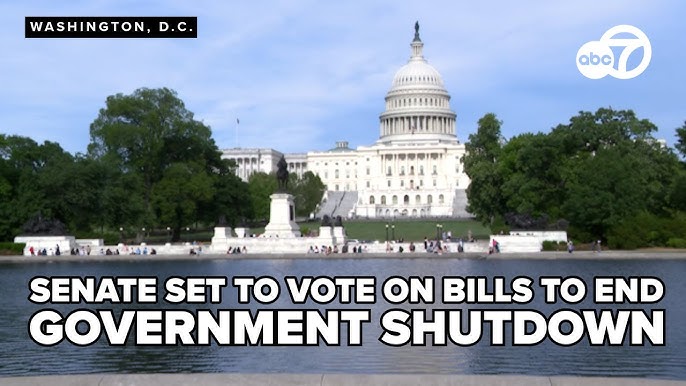
WASHINGTON — America’s partial government shutdown has crossed the two-week mark, and Capitol Hill is preparing for yet another high-stakes roll call. Senate Republicans have teed up a single vote Tuesday on their stopgap funding bill, daring Democrats to either break the impasse or own the continuation of the closure. The chamber’s planned tally will be the eighth Senate vote tied to reopening the government since the standoff began—clear proof of motion without movement. (Facebook)
Live tickers across the networks tell a consistent story: the shutdown sits at Day 14, the Senate returns this afternoon, and the vote is scheduled for the early evening with a 60-vote threshold that Republicans cannot hit on their own. Democrats remain unified in demanding that any short-term funding bill include extensions of health-insurance tax credits, a line they say protects families from premium spikes during a cost-of-living crunch. (CBS News)
Complicating the optics, President Trump—now in his second term—is welcoming Argentina’s President Javier Milei to Washington the same day, a meeting that blends geopolitics, economics, and the raw theater of governing during a shutdown. To supporters, it signals a White House juggling global leadership and domestic brinkmanship; to critics, it’s a jarring split-screen: diplomacy abroad while federal workers at home miss pay. (Reuters)
What’s on the floor: one vote, many stakes
Republicans have consolidated around a House-passed continuing resolution that funds the government into late November. It’s a straight-forward proposition: reopen now, fight about the bigger stuff later. But the Senate rules are the Senate rules—cloture requires 60 votes—and with 53 Republicans in the chamber, GOP leaders need at least seven Democrats to cross over. So far, none have budged. Expect Tuesday’s roll call to be as much about message discipline as mathematics. (CBS News)
Democrats argue that passing a bare-bones bill only resets the countdown clock. They want the health-insurance credit extension included up front, framing it as guard rails for families stuck between stagnant wages and rising premiums. Republicans, for their part, say Democrats are holding paychecks and basic government services hostage to a policy rider, and that credits can be negotiated in the broader spending talks. The two narratives collide at 5:30 p.m. Eastern. (CBS News)
How we got here: eight votes, zero breakthroughs
If it feels like déjà vu, it is. The Senate has been cycling through procedural votes on essentially the same question for more than a week—should the chamber proceed to the GOP short-term funding bill? Each time, Republicans have fallen short of 60. With the House in recess under Speaker Mike Johnson and refusing to take up any Senate-led compromise, the upper chamber has become the only game in town, and “no” remains the scoreboard. (CBS News)
The shutdown’s collateral damage widens daily: the cascading federal back-pay debate for furloughed workers, delayed contracting, reduced services, frayed family finances—while certain functions continue via emergency measures. For workers outside the carve-outs, a missed paycheck is not a talking point; it’s rent, groceries, and medication. (CBS News)
The split-screen presidency: Milei at the White House
The other marquee headline Tuesday is foreign policy. Trump’s meeting with Argentina’s Milei follows Washington’s move toward a dollar swap/financial support package aimed at stabilizing Argentina’s battered economy. It’s a bet on an ideological ally and a message to the hemisphere that the U.S. will invest in partners who embrace market reforms. It’s also a lightning rod: opponents ask why a shutdown America can’t fund itself for two more weeks can marshal dollars and attention for a bailout abroad. Expect both sides to weaponize the optics. (Reuters)
The politics under the hood: what each side is really protecting
For Republicans, the short-term bill is about reopening government without pre-conceding on the thorniest policy fights. They argue that once agencies are funded, both parties can haggle over health credits, immigration riders, and long-term caps without the daily drumbeat of closure headlines. The single-vote strategy—up-or-down, no amendments—is designed to force a clean narrative. (Facebook)
For Democrats, the shutdown is leverage they don’t want to surrender cheaply. The insurance credit extension doubles as policy substance and coalition glue: it protects working- and middle-class households and gives Democrats a tangible deliverable for a restless base that’s endured inflation and housing shocks. Concede the credits now, and Democrats can sell a reopening as relief without retreat. Hold out and lose the public—well, that’s the risk baked into brinkmanship. (CBS News)
What “Day 14” looks like beyond the Beltway
It’s easy to reduce a shutdown to floor charts and vote counts. It’s harder—but necessary—to count the human costs. Flight-training backlogs ripple into regional airline staffing; small federal contractors face cash-flow crunches their credit lines can’t cover; research grants stall; parks close, then reopen partially, then close again. The economy absorbs these shocks unevenly. And for furloughed workers, “eventual back pay” is a promise that doesn’t buy groceries today. (CBS News)
Meanwhile, the historic register grows: at the two-week mark, this is already among the longest shutdowns on record, with no consensus plan to end it. The Senate’s vote count tonight is a mile marker, not necessarily a destination. (NBC Los Angeles)
What would end it? Three realistic off-ramps
- A narrowly tailored compromise in the Senate.
Translate Democrats’ credit extension into a short, time-limited add-on; pass with 60+ votes; pressure the House to swallow it. This preserves Republican messaging (“we reopened”) and gives Democrats a concrete win (“we protected families”). (CBS News) - House returns under pressure.
Public opinion—or market tremors—forces the Speaker to recall members for a vote on the Senate’s product, even if imperfect. That requires a decision that political pain now exceeds intra-party backlash later. (CBS News) - A White House-led side deal.
A small package tied to urgent priorities (aviation safety, disaster aid, or pay guarantees) provides face-saving cover. These deals rarely solve the big fight but can unlock the door. (Watch airline and contractor pressure.) (CBS News)
What to watch in tonight’s vote (and why it matters if it fails)
- The margin. Even in defeat, if Republicans close the gap, leadership can argue that pressure is working. If the margin widens, the narrative flips. (CBS News)
- Any Democratic crossover. A single defection is messaging; several is momentum. So far, there’s no sign of cracks. (CBS News)
- The post-vote microphones. If leaders emphasize progress and “ongoing talks,” staff may be closer than the roll call suggests. If both sides rehearse the same sound bites, prepare for Week Three. (CBS News)
Bottom line: governing by brinkmanship has a body count
Shutting down the government isn’t a budget tool; it’s a blunt instrument that breaks in ordinary hands. It spills beyond Washington fast, tapering services and trust. Tuesday’s single Senate vote is a test: can one chamber convert choreography into compromise, or will the longest-running political drama of the month book another week?
The answer won’t come from the cameras in the well so much as the pressure off-stage—airports, contractors, families waiting on back pay, markets sniffing at risk. If any of those needles move, the stalemate will move with them. If not, we’ll be right back here tomorrow, parsing whip counts and waiting for a number that looks a lot like 60. (CBS News)
government shutdown live updates Day 14, Senate GOP single vote to reopen government, eighth Senate vote to reopen government, health insurance tax credits shutdown, how long will the government shutdown last 2025, Trump meets Argentina’s Milei during shutdown, when will Senate vote to end shutdown, what’s open and closed during government shutdown.

I’m Naveed, based in Paris,with my team I always believed that technology should make life easier not more complicated. That’s why I created Sejda.store: a place where anyone can use powerful online tools without needing special software or technical skills.