
Table of Contents
🌌 Northern Lights Forecast: Where and When to See the Aurora Tonight Across the U.S.
The Northern Lights—one of nature’s most stunning light shows—may be visible much farther south than usual tonight.
According to NOAA’s Space Weather Prediction Center (SWPC), a strong geomagnetic storm caused by solar activity is expected to make the aurora borealis visible across much of the northern United States and possibly parts of the Midwest.
This rare event happens when charged particles from the Sun collide with Earth’s magnetic field and atmosphere, producing glowing bands of light that ripple across the night sky.
Let’s break down what’s happening, why it matters, and how you can see it tonight.
🌞 What’s Causing the Northern Lights Tonight?
Northern Lights Forecast well The Sun has been particularly active in 2025.
NOAA scientists reported a coronal mass ejection (CME)—a huge burst of solar plasma—leaving the Sun a few days ago. When this CME reaches Earth, it disturbs our planet’s magnetic field, triggering a geomagnetic storm.
Northern Lights,According to the Space Weather Prediction Center, tonight’s storm is classified as G3 (strong) on the five-point geomagnetic scale. That means auroras could be visible as far south as:
- Oregon, Nebraska, and Iowa in the west,
- Illinois, Indiana, and Ohio in the Midwest,
- and possibly northern Virginia and Maryland on the East Coast.
That’s a significant shift from the usual northern-latitude visibility of Alaska, Canada, and the upper Midwest.
NOAA’s Aurora Viewline map shows the southern boundary dipping lower than it has in months, giving millions of Americans a chance to see the glow.
“This is one of the strongest solar storms of the current solar cycle,” said Dr. Shawn Dahl, a forecaster at NOAA’s SWPC, in an update released Wednesday.
🛰 The Science Behind the Aurora Borealis
To understand the Northern Lights, it helps to know how Earth interacts with the Sun.
- The Sun emits a solar wind—a stream of charged particles traveling through space.
- Earth’s magnetic field acts like a shield, deflecting most of these particles.
- When solar wind is particularly strong—during a CME—it compresses Earth’s magnetic field and forces particles into the upper atmosphere.
- These particles collide with gases like oxygen and nitrogen, releasing energy in the form of light.
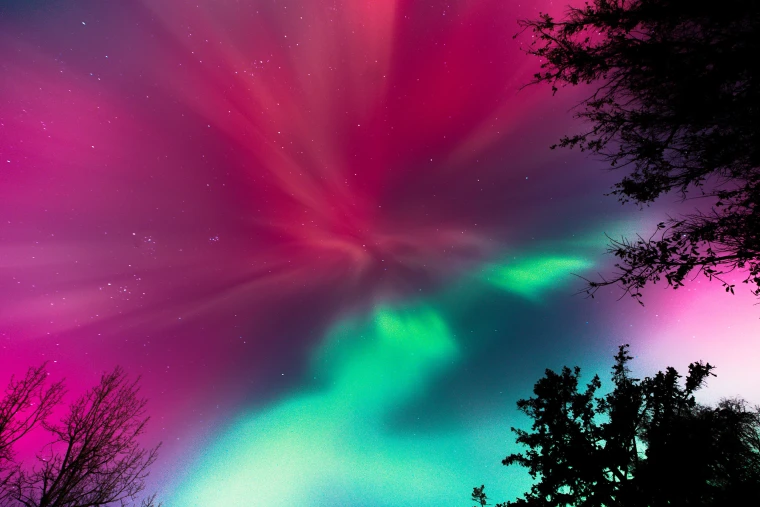
Northern Lights,The color of the aurora depends on the altitude and the type of gas:
- Green: oxygen molecules about 60–150 miles up.
- Red: high-altitude oxygen, above 150 miles.
- Purple or pink: nitrogen molecules interacting closer to the ground.
NASA describes this as “space weather you can see,” a spectacular reminder that our planet and the Sun are constantly connected through electromagnetic energy.
📊 How Strong Is This Storm?
NOAA uses the Kp index to measure geomagnetic activity. The scale runs from 0 (quiet) to 9 (extreme).
- A Kp of 4–5 means auroras can reach the northern U.S.
- A Kp of 6–7 means visibility could extend into the central states.
- A Kp of 8–9 means an aurora could appear even in the southern U.S.—a rare event that happens only a few times per decade.
As of Wednesday evening, NOAA forecasts a Kp index between 6 and 7, meaning skywatchers in about half the U.S. have a realistic chance of seeing faint or bright auroras.
🌎 Where to Look and When
According to USA Today and NASA’s Aurora forecast tools, the best viewing times will be between 10 p.m. and 2 a.m. local time, when the skies are darkest and the magnetic field aligns most favorably.
Best viewing states tonight:
- Northern Idaho, Montana, Washington, and Oregon
- Central Minnesota, Wisconsin, and Michigan
- Portions of Illinois, Iowa, Nebraska, and the Dakotas
- Possible glimpses in Pennsylvania, New York, and northern New England
Even if you’re farther south, don’t lose hope—long-exposure smartphone cameras can capture colors invisible to the naked eye.
📷 Tips for Seeing the Northern Lights Tonight
To make the most of this rare opportunity, follow these practical steps recommended by NOAA and veteran aurora photographers:
- Get away from city lights — Find a dark, open area like a park, field, or lakefront. Light pollution is your worst enemy.
- Face north — That’s where the aurora typically appears in the Northern Hemisphere.
- Check your sky conditions — Clear skies are essential; even thin clouds can block the view.
- Use a tripod and night-mode — A steady camera with long exposure (10–20 seconds) will reveal colors that human eyes can’t detect.
- Be patient — Auroras often brighten suddenly after midnight.
- Dress warmly — Cold weather and waiting outdoors go hand in hand.
If you can, use apps like My Aurora Forecast or SpaceWeatherLive to track the latest Kp index in real time.
🌠 Why This Matters Beyond the Beauty
While the aurora is stunning to watch, it’s also a scientific and technological event.
Strong geomagnetic storms can affect satellites, radio communications, and even power grids.
In 1989, a major storm caused a blackout across Quebec.
The good news: tonight’s G3 storm is far weaker than that, but it’s a reminder that space weather can have real effects on Earth.
NASA and NOAA constantly monitor the Sun’s activity through missions like the Solar Dynamics Observatory to predict and mitigate these risks.
🧠 Fun Aurora Facts
- The word aurora comes from the Roman goddess of dawn.
- The same phenomenon in the Southern Hemisphere is called the aurora australis.
- Jupiter and Saturn also have auroras—hundreds of times more powerful than Earth’s—caused by their giant magnetic fields.
- In ancient times, auroras were seen as omens; Vikings believed they were reflections from the shields of fallen warriors.
📅 How Often Can You See the Northern Lights in the U.S.?
Auroras are more common during peaks of the 11-year solar cycle.
Right now, the Sun is approaching Solar Maximum (2025–2026), meaning more frequent CMEs and stronger geomagnetic storms are likely.
If tonight’s display doesn’t reach your area, don’t worry—experts say there will be multiple chances in the next 12–18 months to witness the Northern Lights again.
✨ Conclusion
Tonight’s aurora forecast is a rare treat for millions across the United States.
Whether you’re an astronomy enthusiast, photographer, or just curious about nature’s wonders, take a few minutes to look up.
Remember: clear skies, dark surroundings, and patience are your best allies.
Even if you don’t see the glow with your eyes, your camera might—and either way, you’re witnessing a cosmic connection between our planet and the Sun.
❓FAQ — Northern Lights Forecast (SEO-Optimized)
1. What causes the Northern Lights?
The Northern Lights, or aurora borealis, occur when charged solar particles collide with Earth’s atmosphere, exciting oxygen and nitrogen atoms that emit visible light.
2. Why are the Northern Lights visible tonight?
A recent coronal mass ejection from the Sun triggered a strong geomagnetic storm (Kp 6-7), making the aurora visible much farther south than usual.
3. Where in the U.S. can I see the Northern Lights tonight?
Forecasts from NOAA show visibility across northern states like Montana, Minnesota, Wisconsin, and Michigan—with possible sightings into Iowa, Illinois, and New York.
4. What time should I look for the aurora?
The best viewing window is from 10 p.m. to 2 a.m. local time, under clear and dark skies facing north.
5. Do I need special equipment to see it?
No—your eyes are enough in dark conditions. However, smartphones with night-mode or long exposure capture more vivid colors.
6. How often do auroras reach the United States?
Moderate auroras reach the northern U.S. several times a year. Strong, southern-visible auroras occur only a few times each solar cycle (about every 11 years).
7. Can solar storms affect power or communication?
Yes, powerful geomagnetic storms can disrupt satellites and power grids, but tonight’s storm is moderate and not expected to cause damage.
8. When is the next good chance to see the Northern Lights?
With the Sun near Solar Maximum (2025–2026), similar aurora events may happen several times in the next year. Monitoring NOAA’s forecasts is the best way to stay updated.
SEO Title:
👉 Northern Lights Visible Tonight Across the U.S. — How and When to Watch the Aurora

I’m Naveed, based in Paris,with my team I always believed that technology should make life easier not more complicated. That’s why I created Sejda.store: a place where anyone can use powerful online tools without needing special software or technical skills.