
Philippines Accuses China
Table of Contents
Philippines Accuses China of ‘Deliberately Ramming’ Government Vessel in South China Sea
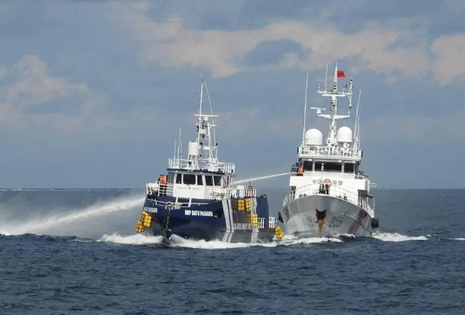
MANILA, October 11, 2025 — Tensions in the South China Sea flared once again Sunday after the Philippines accused a Chinese coast guard vessel of deliberately ramming a Philippine government boat near the disputed Second Thomas Shoal, a flashpoint in one of the world’s most contested waterways.
According to the Philippine Coast Guard (PCG), one of its supply ships — delivering provisions to troops stationed on the BRP Sierra Madre outpost — was struck by a Chinese vessel during what Manila described as “a hostile and deliberate act of aggression.” The incident, which unfolded under gray tropical skies, immediately drew international concern and reignited questions about the future of maritime peace in the region.
China, however, denied any wrongdoing, claiming that the Philippine vessel had “ignored repeated stern warnings” and had “deliberately intruded” into Chinese waters, leading to what Beijing called a “minor collision caused by reckless maneuvering.” (The Guardian)
The diplomatic blame game between the two Asian neighbors has now entered a sharper phase, threatening to destabilize a fragile maritime balance that has already seen near-misses, laser targeting, and water-cannon confrontations over the past year.
The Incident — “A Deliberate Act of Hostility”
The collision took place early Sunday morning near Ayungin Shoal (Second Thomas Shoal), a reef claimed by both Manila and Beijing but located well within the Philippines’ Exclusive Economic Zone (EEZ) under the 1982 United Nations Convention on the Law of the Sea.
The Philippine National Task Force for the West Philippine Sea stated that the Chinese ship “executed a dangerous maneuver, striking the starboard side of our supply boat at close range.”
Coast Guard spokesperson Commodore Jay Tarriela described the event as “not an accident but a deliberate ramming,” adding that the Philippine crew managed to regain control and continue their mission to resupply troops stationed on the rusting Sierra Madre, a grounded warship that serves as a symbolic outpost of sovereignty.
Photographs and video released by Manila show what appears to be the Chinese vessel approaching at high speed before impact. Philippine officials said the crew suffered minor injuries and that no lives were lost.
Philippines Accuses China
China’s Response — Denial and Counter-Accusations
Beijing quickly issued a statement through its Foreign Ministry, accusing the Philippines of “violating China’s territorial sovereignty.” The ministry claimed the Philippine vessel “entered waters under Chinese jurisdiction” and ignored multiple radio warnings.
“The onus lies entirely on the Philippine side,” read the official statement, adding that the Chinese coast guard “acted with restraint and professionalism.”
Chinese state media outlets, including Global Timeshttps://www.youtube.com/watch?v=MIAnNBEv0BY, framed the incident as a “provocation orchestrated by Manila under the influence of foreign powers,” an indirect reference to the United States and Japan — both key allies of the Philippines.
The rhetoric mirrored China’s broader narrative that Western powers are “militarizing” the South China Sea to contain Beijing’s rise, while Manila insists it is merely defending its sovereign rights under international law.
Rising Maritime Tensions and the Shadow of History
This latest Philippines-China South China Sea collision is part of a long pattern of confrontation.
The Second Thomas Shoal has been a flashpoint for years. The Philippines deliberately grounded the BRP Sierra Madre there in 1999 to establish a permanent presence. Since then, a handful of Marines have lived aboard the decaying ship, supplied regularly by small naval and civilian boats — missions that China increasingly disrupts.
Recent incidents include:
- Water cannon attacks (August 2024): Chinese vessels blasted Philippine ships, damaging equipment and injuring crew.
- Laser targeting (February 2025): A Chinese ship reportedly pointed a military-grade laser at a Philippine patrol, temporarily blinding a sailor.
- Radio warnings and blockades: Ongoing intimidation tactics along Manila’s resupply routes.
Each episode erodes trust and pushes both nations closer to confrontation, even as both claim they “seek peace.”
International Reaction — Allies Watch Closely
The United States, bound by a 1951 mutual defense treaty with the Philippines, issued a swift statement condemning “dangerous and unlawful behavior” by China. The U.S. State Department warned that any armed attack on Philippine public vessels “would invoke mutual defense obligations.”
Japan and Australia, two members of the Quad security alliance, also expressed “serious concern,” echoing calls for restraint and respect for international maritime law.
In contrast, Beijing accused Washington of “fueling tension and emboldening provocations,” underscoring how the South China Sea remains a microcosm of the larger U.S.-China power rivalry.
ASEAN, the Southeast Asian regional bloc, urged “calm dialogue,” though analysts note that consensus among its members remains fragile due to China’s economic influence in the region.
Legal Context — Sovereignty vs. International Law
Under the 2016 Hague Tribunal ruling, China’s sweeping “Nine-Dash Line” claim in the South China Sea was declared without legal basis. The ruling affirmed that areas like the Second Thomas Shoal lie within the Philippines’ Exclusive Economic Zone.
However, Beijing has never recognized the verdict, continuing to build artificial islands and deploy coast guard and militia fleets across the sea. Manila has repeatedly invoked the ruling, calling it “final and binding,” while China dismisses it as “a piece of waste paper.”
Legal experts warn that without enforcement mechanisms, international law remains toothless against major powers. “What we’re seeing,” says maritime law scholar Jay Batongbacal, “is law colliding with raw power. And the sea — as always — is the battleground.”
The Human Element — Fishermen Caught in the Middle
Beyond geopolitics, the human cost of the South China Sea dispute is often overlooked. Filipino fishermen report harassment, confiscation of catch, and blocked access to traditional fishing grounds.
Local resident Mario Delos Santos, a 45-year-old fisherman from Palawan, told reporters, “We just want to fish in peace. But every time we go near the shoal, they chase us. It’s like the sea is no longer ours.”
For these coastal communities, the clash between Manila and Beijing isn’t about global power — it’s about survival.
What Comes Next — Diplomacy or Escalation?
President Ferdinand Marcos Jr. convened an emergency meeting of the National Security Council Sunday evening, pledging to “assert Philippine sovereignty with firmness and prudence.”
He called for the Chinese ambassador to provide an explanation, while hinting that the matter could be raised before the United Nations.
Analysts remain divided on whether the incident will lead to greater diplomatic isolation for Beijing or to a cautious backchannel de-escalation. The U.S. Indo-Pacific Command has reportedly increased surveillance in the area, while European powers — including France and the U.K. — have reaffirmed freedom of navigation.
- Philippines says Chinese ship deliberately rammed government vessel
- China Philippines South China Sea collision 2025
- Ayungin Shoal Second Thomas Shoal dispute
- Manila Beijing maritime tensions
- South China Sea live updates and analysis
- US defense treaty Philippines China confrontation
These ensure visibility for readers seeking verified updates, geopolitical analysis, and maritime law context.
Conclusion — The Sea Between Nations
The latest collision between Chinese and Philippine ships underscores the perilous reality of the South China Sea — a region where national pride, strategic interests, and human livelihoods converge.
Every confrontation, no matter how small, risks tipping the balance toward crisis. As both sides trade accusations, the world is left hoping that cooler heads prevail — that diplomacy can still outpace escalation.

I’m Naveed, based in Paris,with my team I always believed that technology should make life easier not more complicated. That’s why I created Sejda.store: a place where anyone can use powerful online tools without needing special software or technical skills.